

Teeth Whitening vs. Veneers: Which Is More Successful?
For many people who want whiter, more aesthetic teeth, one of the most confusing questions is "Is teeth whitening or veneers better?" Both methods improve the smile aesthetically, but their purposes and effects are quite different.
Therefore, making the right choice is very important both for achieving a natural appearance and avoiding unnecessary procedures.
In this article, we will simply discuss the differences between teeth whitening and veneers, their advantages, and which one is more successful in which situation.
What Is Teeth Whitening?
 Teeth whitening (bleaching) is an aesthetic procedure applied to lighten the color of teeth by a few shades. Discolorations on the tooth surface are removed using special whitening agents.
This procedure provides a brighter and cleaner appearance without damaging the tooth structure. It offers aesthetic improvement while preserving the natural tooth structure.
What Is a Veneer?
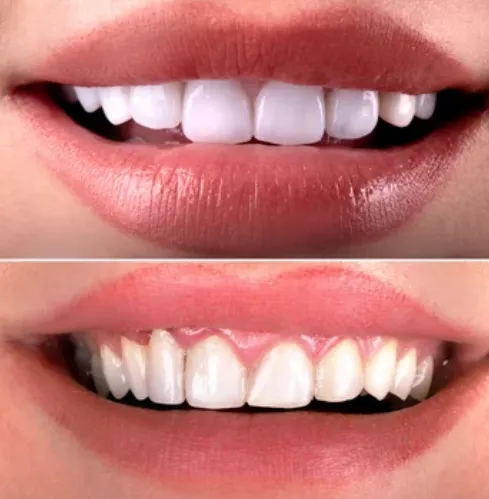 A veneer is a procedure where the outer surface of the tooth is thinned and a porcelain or zirconium material is placed over it. This method can completely change both the color and shape of the tooth.
Veneers correct not only color but also form irregularities. Therefore, they offer a more comprehensive aesthetic solution.
What Is the Main Difference?
The most important difference between teeth whitening and veneers is the level of intervention.
Whitening affects only the color while preserving the natural structure of the tooth. Veneers, on the other hand, completely change the form and appearance of the tooth.
Therefore, whitening is a minimal procedure, while veneers are a more comprehensive treatment.
Which Is More Successful Aesthetically?
The answer to this question depends entirely on the need.
If there is only discoloration on the teeth, teeth whitening yields very successful results. It provides a natural appearance and does not harm the tooth.
However, if there is a shape irregularity, fracture, or large filling on the teeth, veneers offer a more successful result. Because they correct not only the color but also the form of the tooth.
Which Is Better in Terms of Naturalness?
In terms of naturalness, teeth whitening is generally more advantageous because the person's own tooth is preserved.
Veneers are also quite successful aesthetically, but since an entirely new surface is created, the structure is different from a natural tooth.
Therefore, the most natural result is usually achieved with whitening.
Longevity and Lifespan
 Veneers are a treatment that can last for many years. They are quite durable with proper care.
Teeth whitening, however, is not permanent. Discoloration can recur over time, and the procedure may need to be repeated at certain intervals.
Therefore, individuals seeking a long-term solution may prefer veneers.
Procedure Duration
Teeth whitening is usually completed in a short time. In some cases, results can even be achieved in a single session.
Veneer treatment, on the other hand, may take several sessions. The process is slightly longer due to the impression-taking and manufacturing stages.
Who Is Teeth Whitening Suitable For?
 Teeth whitening is an ideal option in the following situations:
- If there is only discoloration on the teeth
- If the tooth structure is healthy
- If preserving the natural appearance is desired
In these cases, whitening provides a sufficient and effective solution.
Who Is a Veneer More Suitable For?
Veneers are preferred for more comprehensive problems:
- If there are fractures or cracks in the teeth
- If there is a shape irregularity
- If there are large fillings or color changes
In such cases, veneers provide more successful results.
Which Is More Advantageous in Terms of Cost?
Teeth whitening is generally more economical compared to veneers. Therefore, it is ideal for those seeking a quick and cost-effective solution.
Veneers can be more costly, but due to the comprehensive solution they offer, they can be advantageous in the long term.